Unlocking the Secrets of Average True Range (ATR) for Successful Cryptocurrency Trading
What Is Average True Range (ATR) and Why Is It Important for Traders?
Understanding ATR in Crypto Trading: Average True Range (ATR) is a crucial technical indicator pioneered by J. Welles Wilder Jr. that assesses market volatility by examining price movements over a defined period. In the fast-paced world of crypto trading, where price shifts are commonplace, ATR becomes an essential tool. This indicator calculates the average of true ranges over a set number of periods, typically 14, allowing traders to anticipate potential price fluctuations.
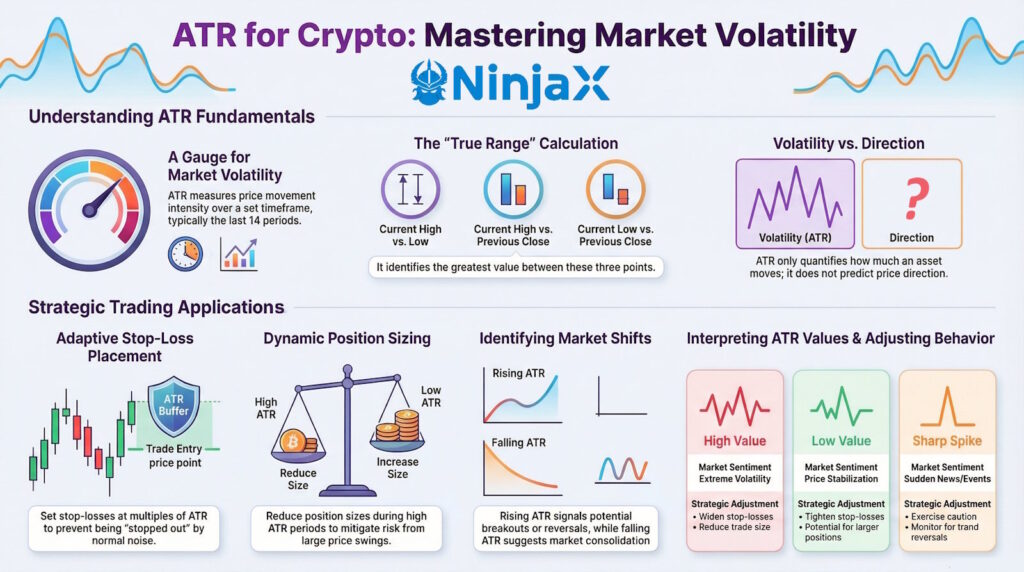

For instance, when Bitcoin experiences significant price movements across several days, a high ATR emerges, reflecting this volatility and signaling traders to prepare for possible quick changes in market dynamics.
To compute ATR, traders first determine the true range for each period. This involves identifying the largest value among three aspects: the difference between the current high and low, the difference between the previous close and the current high, and the difference between the previous close and the current low. This detailed process ensures ATR captures the entire range of price activity, making it an essential instrument for traders.
For example, if Ethereum shows a true range of $100, the ATR is calculated by averaging this figure over the selected timeframe, providing a clear indication of expected price movements.
Key Components of Average True Range (ATR) Explained
To fully grasp the significance of ATR, it is crucial to understand its fundamental components: high, low, and close prices. The high price denotes the peak value reached during a trading session, while the low price signifies the minimum value. The close price reflects the final price at which the asset trades at the session's conclusion. Analyzing these elements allows crypto traders to interpret market dynamics effectively, going beyond mere directional trends.
Understanding how these prices interact helps traders identify patterns of volatility and potential market turning points. For example, if a cryptocurrency consistently shows high highs and low lows, it may indicate increased market activity and viable trading opportunities. Conversely, stable prices with minimal changes may suggest a consolidation phase, prompting traders to adapt their strategies accordingly. Hence, mastering these crucial elements is vital for making informed choices in the rapidly evolving world of crypto trading.
Practical Uses of ATR in Trading Strategies
ATR has become an indispensable tool for numerous traders in the cryptocurrency market due to its adaptability and effectiveness in assessing risk. One of its primary functions is in setting stop-loss levels. By using ATR as a reference, traders can position a stop-loss order that corresponds with current market volatility. For instance, if a trader enters a long position in a volatile altcoin, they might establish a stop-loss order at a specific multiple of the ATR below the entry price to safeguard against unforeseen price movements.
Another beneficial application of ATR is in determining position sizes. This flexible approach enables traders to modify their risk exposure according to prevailing market conditions. In a high-volatility setting, such as trading emerging altcoins, traders may choose to reduce their position size to limit risk. Conversely, in more stable asset conditions, they may increase their position size to capitalize on lower volatility. By incorporating ATR into their trading frameworks, crypto traders can refine their decision-making processes and enhance their risk management, ultimately leading to better trading results.
How Is Average True Range (ATR) Utilized in Cryptocurrency Trading?
Understanding the Methodology Behind ATR Calculation
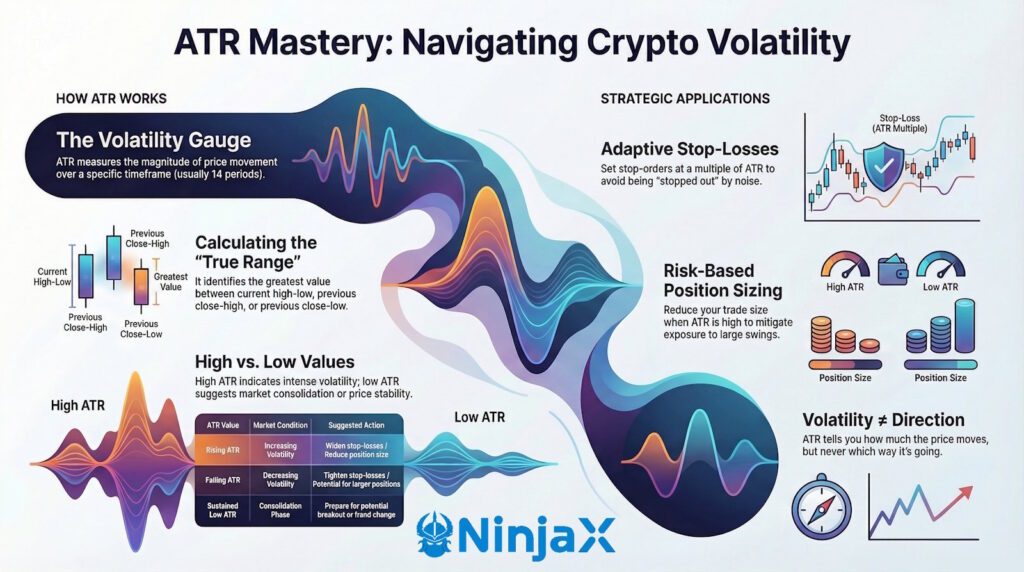
Gaining a thorough understanding of the ATR calculation method is essential for crypto traders aiming to utilize this indicator effectively. The first step involves determining the true range for each period. As previously discussed, true range is identified by taking the highest value among three criteria: the difference between the current high and low, the difference between the previous close and the current high, and the difference between the previous close and the current low. After establishing the true range for each period, the next step is to compute the ATR by averaging these true ranges over the specified number of periods.
The smoothing technique commonly employed is the exponential moving average (EMA), which allows ATR to respond more rapidly to recent price movements. This results in a more accurate representation of volatility, especially during sudden market fluctuations. For example, if a trader notices an increase in Bitcoin’s ATR following a substantial price surge, they might view this as a signal to reassess their trading strategy. This systematic calculation not only highlights current market conditions but also provides traders with insights to optimize their entry and exit strategies.
Variables Influencing the Precision of ATR Values
The accuracy of ATR can be impacted by various elements, particularly within the ever-changing landscape of cryptocurrency trading. Market liquidity plays a crucial role; higher liquidity generally leads to more reliable ATR readings, reflecting actual price movements rather than artificial volatility caused by limited trading activity. Similarly, trading volume is vital; low trading volume can result in erratic price fluctuations that distort ATR calculations.
Moreover, different cryptocurrencies exhibit unique trading behaviors influenced by external factors such as news, regulatory changes, and market sentiment. Traders must remain alert in adjusting their ATR parameters based on observed trends. For example, in a highly volatile market, like meme coins, it may be wise to shorten the ATR calculation period to capture rapid price changes accurately. By recognizing these influential aspects, traders can maximize ATR's effectiveness and adapt their strategies accordingly.
What Makes ATR an Indispensable Tool for Traders?
The widespread appeal of ATR among crypto traders stems from its straightforwardness and practical applications in risk management and strategy formulation. This indicator offers a clear numerical representation of market volatility, empowering traders to make informed decisions. Its user-friendly nature allows traders—whether beginners or experienced professionals—to seamlessly integrate ATR into their trading routines.
Additionally, ATR’s flexibility is a significant advantage. Many traders utilize it to dynamically adjust their stop-loss orders; for instance, a rising ATR may lead a trader to widen their stop-loss, while a declining ATR might prompt a trader to tighten it. This adaptability to changing market conditions proves invaluable in the often chaotic crypto trading arena. However, consistently monitoring ATR is crucial, as failing to track its fluctuations can hinder a trader’s ability to respond effectively to market shifts.
Incorporating ATR into Strategic Trading Practices
Integrating ATR into trading strategies can significantly enhance a trader’s decision-making and risk management capabilities within the cryptocurrency market. One of the most effective applications involves setting adaptive stop-loss orders. By utilizing ATR to determine the appropriate distance for stop-loss orders based on current volatility, traders can protect their positions against abrupt market changes. For instance, during a volatile trading session, a trader may set their stop-loss further away, reflecting a higher ATR, thus reducing the likelihood of being stopped out of a position due to standard price fluctuations.
Furthermore, ATR can assist in identifying optimal entry points. During times of increased volatility, traders may seek opportunities to enter positions when the ATR spikes, indicating potential price reversals or breakout patterns. This proactive approach encourages traders to act rather than react, allowing them to leverage market momentum effectively. Additionally, ATR can help traders dynamically adjust their position sizes based on calculated volatility, ensuring that their risk exposure aligns with current market conditions and facilitating more informed, strategic trading decisions in the constantly changing cryptocurrency landscape.
Decoding ATR Values for Enhanced Trading Decisions
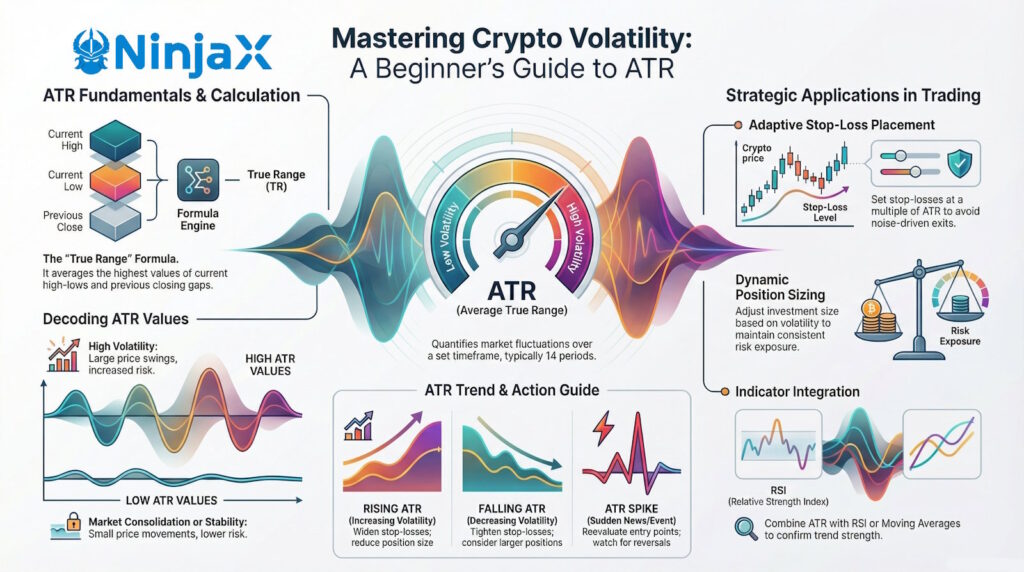
Interpreting ATR values is vital for assessing price volatility in the cryptocurrency trading market. An increasing ATR signifies rising market volatility, which may indicate heightened uncertainty or possible price swings. In such circumstances, traders often modify their strategies—such as widening stop-loss limits or decreasing position sizes—to mitigate risks. For example, if the ATR for Litecoin spikes, traders may interpret this as a sign of imminent price fluctuations, prompting them to reevaluate their positions or entry points.
Conversely, a declining ATR suggests reduced volatility, potentially indicating a stabilization phase within the market. During these times, traders might adopt a more aggressive approach, taking larger positions or initiating new trades, anticipating that price movements will remain contained. Understanding the implications of varying ATR values empowers traders to adapt their strategies dynamically, ensuring they remain responsive to changing market conditions. By effectively interpreting ATR, traders can enhance their strategic decision-making processes and improve their overall trading performance.
Expert Insights on Effectively Utilizing Average True Range (ATR) in Crypto Trading
Advanced Strategies for Interpreting ATR Effectively
For experienced traders, employing advanced ATR interpretation techniques can significantly enhance their trading strategies. A powerful method involves combining ATR with other technical indicators to gain deeper insights into market trends. For example, pairing ATR with the Relative Strength Index (RSI) can provide valuable information regarding overbought or oversold conditions relative to volatility. This combination allows traders to refine their entry and exit points, thereby improving their success rate.
Another effective strategy is to observe ATR in conjunction with moving averages. By analyzing ATR relative to both short- and long-term moving averages, traders can identify potential trend reversals or continuations. This integration allows for a holistic view of market conditions, enabling more informed decision-making. Here are some key integration strategies:
- Combine ATR with RSI to assess market conditions effectively.
- Utilize ATR with moving averages to identify emerging trends.
- Analyze ATR alongside Bollinger Bands to gauge volatility breaks.
- Integrate ATR with Fibonacci retracement levels for improved entry points.
- Use ATR with candlestick patterns to confirm price action.
- Employ ATR to complement volume indicators for insights into market strength.
- Analyze historical ATR values to fine-tune risk management strategies.
- Apply ATR for backtesting trading strategies to enhance performance.
Implementing these strategies enables traders to interpret ATR signals with greater precision, ultimately resulting in more effective trading outcomes. Real-world applications have demonstrated that traders who leverage ATR alongside other indicators often outperform those who rely solely on individual metrics.
Identifying Signals of Market Volatility Effectively
Recognizing the signs of market volatility is crucial for traders aiming to navigate the often unpredictable cryptocurrency landscape. Experts emphasize that rising ATR values frequently indicate increasing market uncertainty. This knowledge is essential for traders to adjust their strategies and proactively mitigate potential risks. For instance, upon observing a sharp increase in ATR, traders may consider reducing their positions or tightening risk management to address heightened volatility.
Additionally, traders must remain vigilant in interpreting ATR signals. Distinguishing between temporary spikes in ATR and sustained volatility trends is vital. Temporary spikes may arise from sudden news events or market reactions, while sustained increases in ATR suggest a more significant shift in market sentiment. By closely monitoring these fluctuations, traders can refine their strategies and proactively respond to changing market conditions, thereby avoiding undue losses during turbulent periods.
Optimizing ATR Settings for Different Cryptocurrencies
Customizing ATR settings for various cryptocurrencies is essential for maximizing their effectiveness across different assets. Each asset class behaves uniquely, influenced by factors such as market liquidity, trading volume, and investor sentiment. Therefore, traders should tailor their ATR settings based on the specific characteristics of each cryptocurrency they engage with. For example, traders might shorten their ATR period when trading high-volatility altcoins to capture rapid price movements more accurately.
In contrast, when trading more stable cryptocurrencies like Bitcoin or Ethereum, traders may opt to extend their ATR period. This adjustment provides a broader perspective on market trends without being overly influenced by short-term price movements. Additionally, applying expert-recommended methods for varying trading scenarios ensures that ATR remains a valuable tool, delivering reliable insights regardless of the asset being traded. By optimizing ATR settings, traders can improve their strategic decision-making and overall trading performance.
Utilizing ATR for Effective Risk Management and Position Sizing
Employing ATR for position sizing is a powerful strategy that aids traders in effectively managing risk in the volatile crypto market. By calculating position sizes based on current ATR values, traders can tailor their exposure to market movements. This approach is especially beneficial in high-volatility environments where price fluctuations can be substantial. For instance, if a trader notices that Ethereum exhibits a high ATR, they might decide to reduce their position size to minimize the impact of potential price swings.
Experts recommend a systematic approach to position sizing based on ATR readings. For example, traders can determine their position size by dividing their total capital by a multiple of the ATR value. This method ensures that traders maintain consistent risk exposure relative to market volatility, enhancing portfolio protection. Moreover, adjusting positions in volatile assets allows traders to avoid overexposure during market swings, ultimately improving their overall risk management strategies. By integrating ATR into their position-sizing protocols, traders can navigate the unpredictability of crypto markets with greater assurance.
Incorporating ATR into Trend Following Strategies for Enhanced Performance
Integrating ATR into trend-following strategies can significantly improve trading outcomes in the cryptocurrency market. Professionals emphasize the necessity of using ATR to establish dynamic stop-loss and take-profit levels that fluctuate with market volatility. For instance, during a Bitcoin uptrend, traders can apply ATR multiples to trail their stop-loss orders, ensuring profits are protected while allowing the trade to continue. This tactic acts as a safeguard against sudden price reversals while capturing potential upside gains.
Furthermore, using ATR in trend-following strategies encourages traders to uphold discipline and avoid emotional decision-making. By adhering to predetermined ATR-based stop-loss distances, traders can sidestep the pitfalls associated with reacting to market noise. This systematic approach enhances the probability of sustained profitability in dynamic environments. As traders refine their trend-following strategies utilizing ATR, they can boost their overall performance and adapt more effectively to shifting market conditions.
Evidence-Based Benefits of Average True Range (ATR) in Crypto Trading
Fortifying Risk Management Techniques through ATR
Utilizing ATR can significantly strengthen risk management strategies in the cryptocurrency trading landscape. Research indicates that ATR serves as a crucial tool for establishing adaptive stop-loss levels, particularly during periods of heightened volatility. By adjusting stop-loss orders based on ATR readings, traders can avoid premature exits from positions during ordinary price fluctuations, ultimately minimizing losses.
For instance, consider a trader employing ATR to set a stop-loss on an altcoin that suddenly experiences spikes amid market buzz. By referencing the ATR value to determine an appropriate stop-loss distance, the trader can maintain discipline and avoid being stopped out during typical price movements. This evidence-based practice highlights ATR’s role in promoting a disciplined trading approach, ensuring that traders remain committed to their strategies even in the face of market turbulence.
Enhancing Trade Timing with ATR Insights
ATR helps in pinpointing optimal entry points by offering valuable signals regarding shifts in market volatility. Research suggests that traders who effectively leverage ATR can seize market momentum, maximizing their profit potential while minimizing emotional decision-making. For example, when ATR values rise sharply, indicating increased market activity, traders can use this information to enter positions at strategic moments and harness volatility.
Moreover, incorporating ATR into trading strategies cultivates adaptability among traders. By recognizing when volatility is rising or falling, traders can adjust their entry and exit points accordingly. This flexibility aids traders in avoiding the pitfall of chasing losses or executing trades motivated by fear or greed. Ultimately, the ability to enhance trade timing through ATR leads to more informed decisions and improved overall performance in the crypto market.
Boosting Trading Performance through Effective ATR Utilization
Evidence suggests that integrating ATR into trading strategies can lead to significantly improved overall performance. By providing a clear measure of market conditions, ATR enables traders to refine their tactics and enhance their profitability within the cryptocurrency space. Traders who consistently implement ATR often experience higher success rates due to their ability to make informed decisions based on detailed insights into market volatility.
For instance, traders who use ATR to identify optimal stop-loss levels and entry points typically outperform those who do not. The systematic application of ATR fosters a disciplined trading approach, allowing users to navigate the complexities of the crypto market with increased confidence. Over time, this evidence-based trading strategy can lead to sustained profitability and a more robust trading portfolio, establishing ATR as an invaluable tool for crypto traders.
What Are the Potential Drawbacks of ATR in Trading?
Challenges Faced in Trending Markets with ATR
Despite its usefulness, ATR does have limitations, particularly in trending markets. A key drawback is that ATR does not forecast the direction of price movement; it merely quantifies volatility. This characteristic can mislead traders who depend solely on ATR for their decision-making processes. In volatile crypto markets, where price fluctuations can be sharp and unpredictable, traders must exercise caution. For instance, if a trader observes a high ATR but does not consider other factors, they might mistakenly interpret volatility as a signal to enter a long position, only to encounter a sudden reversal.
Understanding these limitations is essential for traders, emphasizing the necessity of using ATR alongside other indicators and market analysis methods. Traders should adopt a comprehensive approach, utilizing ATR as one of several tools to effectively navigate the unpredictable landscape of crypto trading.
The Risks of Overreliance on Historical ATR Values
Another potential drawback of ATR is the risk of overreliance on historical data. Traders who depend too heavily on past ATR values may ignore current market conditions and events that can dramatically sway price movements. This reliance can lead to inaccurate forecasts, particularly in the fast-paced realm of crypto trading, where news and sentiment can shift rapidly.
To counteract this risk, traders must maintain a balanced perspective by integrating real-time data and market analysis into their decision-making processes. By combining ATR with real-time news and sentiment assessments, traders can ensure that their strategies remain relevant and responsive to sudden market changes. This holistic approach enhances the effectiveness of ATR and reduces the likelihood of making uninformed trading decisions.
Strategies to Mitigate ATR Limitations in Trading
To address the limitations of ATR, traders can adopt various strategies to diversify their analytical tools and strengthen their trading frameworks. Incorporating additional technical indicators alongside ATR can provide a more comprehensive view of market conditions, empowering traders to make well-informed decisions. For instance, combining ATR with trend-following or momentum indicators, such as MACD, can yield better insights into market behavior.
Moreover, regularly backtesting trading strategies can help traders uncover potential flaws and adjust their methods accordingly. This practice nurtures adaptability, ensuring traders can navigate crypto volatility more effectively. By diversifying their analytical techniques and continuously refining their strategies, traders can mitigate the impact of ATR’s inherent limitations and enhance their overall trading success.
Practical Strategies for Effectively Utilizing ATR in Trading
Integrating ATR with Additional Analytical Tools for Better Insights
Integrating ATR with other technical analysis tools can create a robust framework for evaluating market conditions within the cryptocurrency space. By combining ATR with moving averages, traders can attain a more comprehensive view of price dynamics and volatility trends. For example, when ATR aligns with a moving average crossover, it can provide strong signals for potential entry or exit points, thereby enhancing decision-making.
Additionally, pairing ATR with other volatility indicators, such as Bollinger Bands, can yield valuable insights into price breaks and potential reversals. By observing how ATR values interact with these indicators, traders can adapt their strategies to better capitalize on market movements. Here are practical application tips:
- Use ATR alongside moving averages to confirm market trends.
- Combine ATR with RSI to analyze overbought or oversold conditions effectively.
- Incorporate ATR with Bollinger Bands to identify volatility breaks.
- Utilize ATR in conjunction with Fibonacci retracement levels for enhanced precision.
- Employ ATR with candlestick patterns to confirm price action signals.
- Integrate ATR with volume analysis to assess market strength and activity.
- Examine historical ATR data to refine trading strategies and methodologies.
- Use ATR for backtesting to evaluate past performance and strategies.
By effectively integrating ATR with other tools, traders can enhance their analytical capabilities, ultimately leading to more informed trading decisions and improved performance in the competitive crypto market.
Setting Realistic Expectations When Utilizing ATR
Traders must establish realistic expectations when employing ATR as a volatility assessment tool. Understanding that ATR measures volatility rather than directional movement is crucial for effectively managing outcomes. Recognizing that ATR is not a predictive tool helps traders avoid making impulsive decisions based on transient price movements. Instead, traders should view ATR as a valuable resource that informs their strategies while maintaining a broader perspective on overall market trends.
Furthermore, ongoing education and adaptability are vital. As market conditions evolve, traders should be prepared to adjust their strategies in response to new information and changing dynamics. This balanced approach fosters a sustainable trading mindset, allowing traders to manage risk effectively and navigate uncertainties in the cryptocurrency landscape. By setting realistic expectations with ATR, traders can focus on developing disciplined, evidence-based trading strategies that yield long-term success.
Developing Long-Term Strategies Centered Around ATR
Building long-term strategies utilizing ATR requires consistent monitoring and adjustment to accommodate the ever-evolving cryptocurrency market. Traders should regularly analyze ATR values and volatility patterns to refine their methodologies and adapt their strategies as necessary to stay aligned with market conditions. This proactive approach empowers traders to evolve their methods over time, achieving better results amid persistent volatility.
Additionally, keeping a trading journal can aid traders in documenting their decision-making processes and outcomes when using ATR. By reflecting on past trades and evaluating their results, traders can identify performance patterns, enabling strategic adjustments in the future. Over time, this practice can significantly enhance ATR’s effectiveness in their trading strategies, leading to improved decision-making and overall success in the dynamic crypto trading landscape.
Frequently Asked Questions (FAQs) Regarding ATR
What is ATR in cryptocurrency trading?
ATR, or Average True Range, is a volatility indicator that measures market fluctuations over a specified timeframe, assisting traders in assessing potential price movements in cryptocurrencies.
How is ATR calculated in trading?
ATR is computed by determining the true range for each period and averaging those values over an established number of periods, typically 14.
What does a high ATR value signify?
A high ATR value indicates increased market volatility, suggesting that traders may face larger price swings and should consider adjusting their risk management strategies accordingly.
How can traders utilize ATR for establishing stop-loss orders?
Traders can set stop-loss orders based on ATR by positioning them at a multiple of the ATR below their entry price to accommodate market volatility.
What factors can affect the accuracy of ATR readings?
Market liquidity and trading volume are key factors that can influence ATR’s accuracy; low liquidity can lead to erratic price movements, skewing ATR calculations.
Why is ATR a popular tool among traders?
ATR’s popularity arises from its simplicity and practicality in risk management, providing clear insights into market volatility without necessitating complex calculations.
How can ATR assist in trade timing?
ATR can help traders identify optimal entry and exit points by signaling shifts in volatility, enabling them to capitalize on market momentum while minimizing emotional decisions.
What are the limitations associated with using ATR?
The primary limitations of ATR include its inability to predict price direction and the risk of overreliance on historical data, which may overlook current market conditions.
How can traders mitigate the shortcomings of ATR?
Traders can address ATR’s limitations by diversifying their analytical tools, combining them with real-time data analysis, and regularly backtesting their strategies for effectiveness.
Can ATR be utilized for position sizing in trading?
Yes, ATR can be effectively used for position sizing by calculating position sizes based on current volatility levels, allowing traders to manage their risks more efficiently.





No responses yet