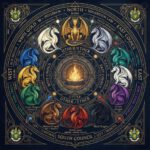
Explore the remarkable tale of Rhodri Mawr (Uther Pendragon) and the young Myrddin (Merlin) as they unveil the concealed red and white dragons beneath the crumbling walls of Dinas Emrys in 853.
Editorial Note: Direct dialogue, individual character thoughts, and narrative scene settings are artistic interpretations and should be perceived as inferred. Meanwhile, historical geopolitical events, physical landscapes, archaeological sites, and customary laws are individually referenced as documented, genealogies, or traditions.
Understanding the Ruins on the Mountain Scarp
Fires from Powys still drifted across the high passes of Eryri. Documented
In spring, King Burgred’s Mercian spearmen infiltrated the border, bolstered by the wealth of Wessex. Documented They set ablaze the timber halls along the upper Severn, forced cattle into ditches, and dismantled the border ramparts, retreating behind their palisades to let winter complete the destruction that their flames had begun.
Rhodri ap Merfyn resolved not to let winter catch him unguarded.
Positioned on the narrow peak of Dinas Emrys, high above the dark surface of Llyn Dinas, he surveyed the scene. Documented The wind howled from the crags of Yr Wyddfa, biting with early sleet. Documented Behind him stood his penteulu, his captains, and the chief of his builders.
“The Roman road along the valley floor is our lifeline,” Rhodri declared. Documented His voice was coarse, scarred by smoke. “If the Saxons advance north when the frost hardens the bogs, they will trap us here. We cannot defend this road from a ditch. We must reconstruct the stone crown.”
The master builder spat into the scree. “The old structure is compromised, my King. The mountain rejects it.”
“Then dig to the core,” Rhodri commanded. “Lay dry-stone footings five paces thick. Embed them into the native granite. Construct a gate capable of withstanding an iron ram.”
Uncovering the Subterranean Slip-Plane
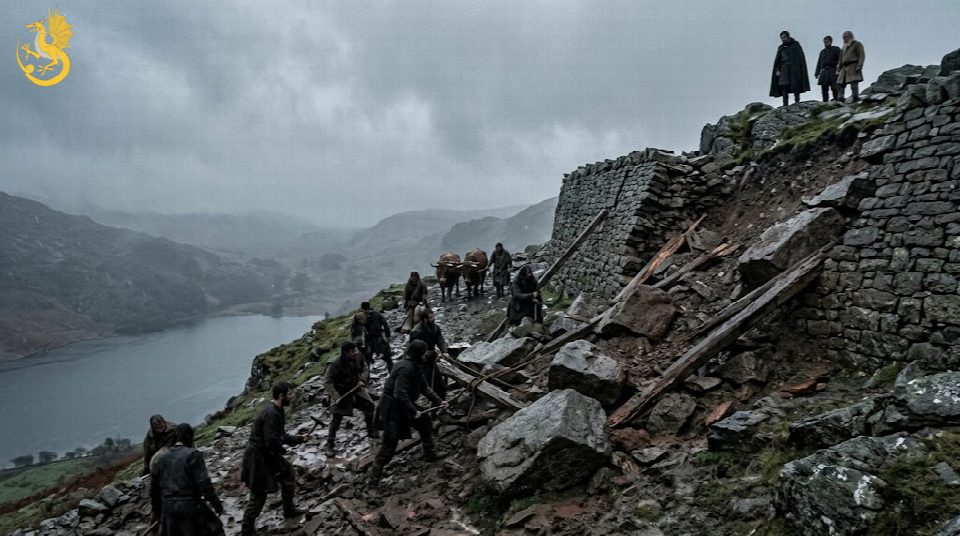
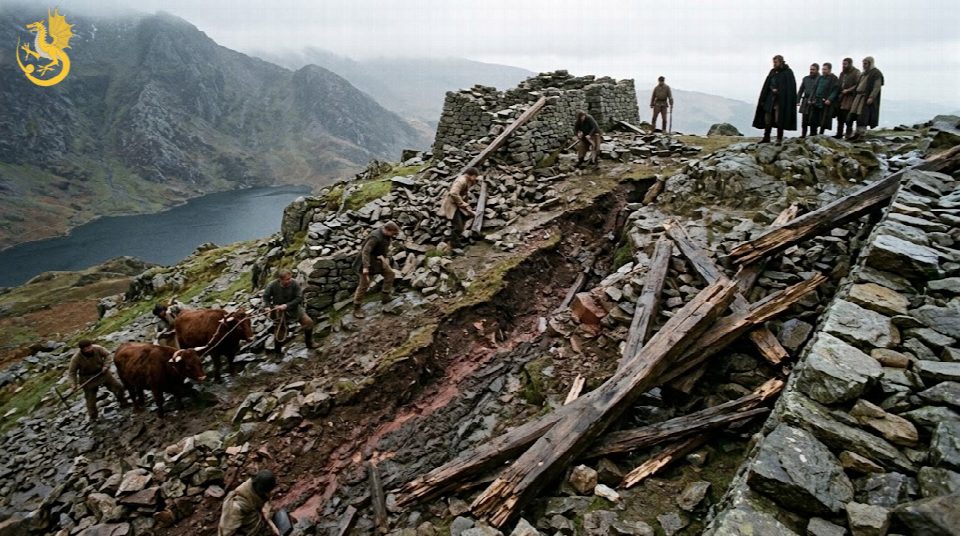
For a fortnight, three hundred men laboured tirelessly on the terraces. Oxen succumbed on the steep inclines, hauling oak beams from the lower valley. Masons prised apart split boulders from the scree slopes, shaping them with iron picks and establishing the lower revetments along the southern scarp.
On the fourteenth night, the mountain responded.
There was no storm. No Saxon warband crept past the valley sentries. Yet at the third watch, a deep, subterranean rumble resonated through the bedrock. The men resting by the valley camp woke to the sound of grinding stone.
By dawn, Rhodri ascended the slope.
The eastern revetment had crumbled. The newly raised dry-stone wall, eight feet of fashioned granite, had buckled inward, fracturing along a diagonal line. The timber beams lay splintered in the mud. More troubling still, the very earth where the foundations lay had transformed into a foul, liquefied sludge of red clay and grey shale that swallowed a man’s leg up to the knee.
“The ground has rotted,” the builder murmured, his face pale beneath his beard. “We clear it, we reset the stones, and by morning the hill will cast them into the tarn.”
Rhodri turned to the men behind him.
These were the penceirddiaid and the court seers of Gwynedd, men who wore silver torcs and claimed descent from the druidic schools of Môn. They had counselled Rhodri’s father, Merfyn Frych. Genealogies They had recited the verses of Taliesin while the Mercian border burned. Tradition
“Speak,” Rhodri urged. His hand rested on the pommel of his spatha. “Why does the mountain reject my stone?”
The chief seer, an elder named Cynfarch, whose eyes were clouded with cataracts, stepped forth. He held a staff of rowan wrapped in bronze.
“The stone is not lifeless, King,” the elder intoned. “This hill was consecrated long before the Caesars set foot on this isle. It is the seat of Ambrosius. The spirit of the mountain is starved. It demands a foundation sacrifice.” Tradition
The captains stiffened.
“What blood?” Rhodri inquired, his eyes narrowing.
“A puer sine patre,” the seer whispered. “A boy born without a mortal father. A seed cast into the earth with no kin to avenge him, no clan to claim his galanas. Documented Spill his marrow across the fractured rock. Anoint the bed-stones with his throat-blood. Only then will the bedrock bind to your iron.” Tradition
Rhodri glanced at the shattered masonry, then down at the empty road below where the Mercian horns might soon sound before the first snow.
“Send two riders,” the King instructed his captain. “Ride south into Dyfed. Search every cantref along the Roman road until you find him.” Documented
Encountering the Brawling Boys of Caerfyrddin
The King’s emissaries crossed the Teifi and entered the muddy lanes of the ancient Roman civitas of Caerfyrddin three days later. Documented
They avoided the priests at the church and did not seek out the chieftain’s hall. Those searching for a child without a clan search where the river casts its refuse.
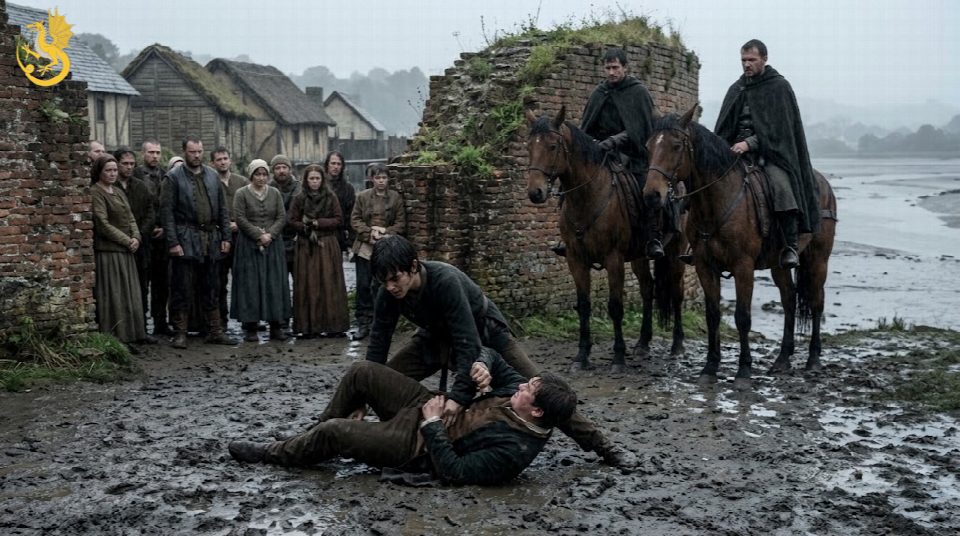
Near the crumbling stone walls of the ancient Roman amphitheatre, where local boys threw stones at birds wading in the muddy Tywi, a rowdy argument pierced through the grey drizzle. Documented
The riders halted their mounts behind a decaying brick wall, listening intently.
Two youths wrestled fiercely in the black silt. One was broad-shouldered and well-fed, the son of a local magistrate, his linen tunic torn at the seam. The other was thin, dark-haired, wild as a dog-otter, barefoot and muddy, wearing a coarse wool cloak fastened with a boar’s tusk.
The magistrate’s son shoved the wild boy forcefully into the clay.
“Why do you speak against me?” the larger boy snarled, wiping blood from his split lip. “You do not belong to the town! You have no hearth! You are a bastard without a father, discarded in the ditch like a drowned pup!” Tradition
The dark-haired boy sprang up immediately, grabbing a fistful of river gravel and throwing it into the other’s eyes. Before the magistrate’s son could clear his vision, the wild boy lunged with frightening speed, driving his shoulder into the larger youth’s ribs, slamming him back into the mud with a force that knocked the breath from his lungs.
“My mother died with the water running off her face,” the wild boy spat, straddling his chest, his fists clenched. “And the earth has more fathers for me than your fat house will ever hold!”
The magistrate’s son scrambled away in fear, coughing up mud as he retreated towards the timber houses.
The two northern riders exchanged a cold, calculating glance. The captain urged his horse forward through the puddles, drawing reined-in iron over the breathless youth.
“You have no sire, boy?” the captain demanded.
The boy rose from the silt, wiped his muddy nose with his forearm, and looked straight into the horseman’s face.
“Ask the river,” the boy replied.
The Midwife’s Caban Encounter
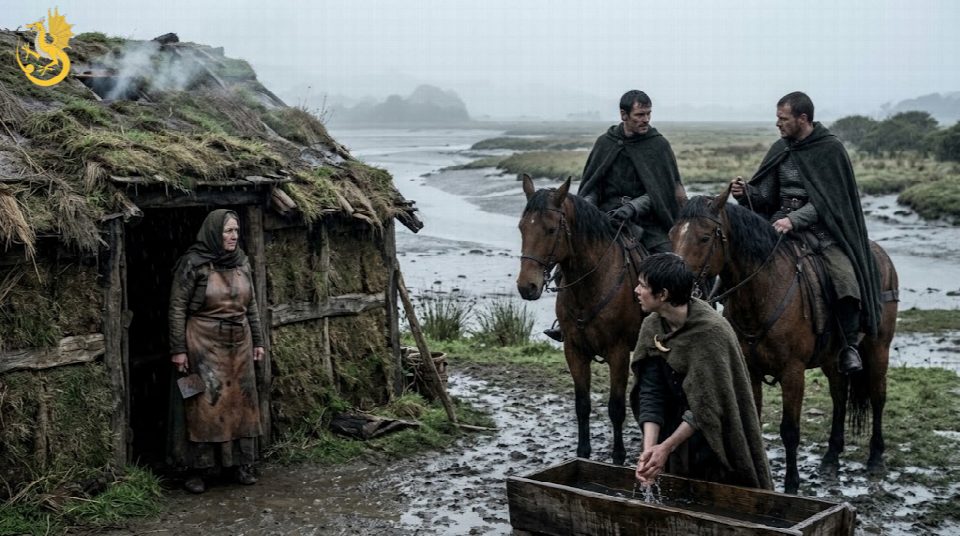
The emissaries followed the boy back towards the salt-marshes behind the amphitheatre, where tanning pits drained into the tidal creek. Documented
There stood a low turf hovel, roofed with rotting reeds. The woman who emerged at the sound of hooves was known as the Gwrach: the midwife, the bone-setter, the one summoned in the dead of night when labouring mothers turned blue and the church bells were of no use.
She stood in the doorway with an iron scraper in her hand, wiping sheep grease onto a stained leather apron.
“You smell of northern horses,” she said, squinting through the mist at the two armed men. “And slaughter.”
“The boy was named in the mud,” the captain stated. “The magistrate’s whelp called him fatherless. The town confirms it.”
The woman spat a dark mouthful of chewed bark onto the threshold.
“He has no father of man’s blood. His mother crawled from the Teifi woods with her belly swollen, her feet bleeding from the brambles. I pulled the child from her body by candlelight. Before the cord was knotted, the red flux took her. She never revealed a name, and no man in Dyfed ever came forward to pay a farthing for her bed.”
“Then the King claims him,” the captain replied. “He rides north.”
The woman glanced at the boy, who was already rinsing his bloody knuckles in a water trough.
“Take him, then,” she said with a dry, gravelly laugh. “You think you are leading a lamb to the altar. He has lived in the limestone caves and slate crevices since he could crawl. He can vanish for four days at a time, living on raw trout and adder-grass, listening to the bedrock. If you take him to your King, ensure your King knows how to hold wild bees without getting stung.”
The boy stepped between the horses. From his tunic, he produced two smooth river stones, turning them over in his fingers.
“Why does Rhodri need a boy from the mudflats?” he inquired.
“For your blood,” the rider answered plainly.
“Your walls will not endure,” the boy laughed.
The boy struck the stones together.
The sound that rang through the dreary drizzle was not a dull clink of limestone. It was a clear, resonant, metallic ring, pure as an anvil, echoing in the damp air like struck bronze. The captain’s warhorse shied, tossing its head in sudden alarm.
The youth gazed towards the northern road where the Cambrian ridges disappeared into cloud. Documented
“Tell your King to save his bronze bowl,” the boy declared. “I will come. His seers are digging in the wrong dirt, and I wish to see how much of the mountain they have ruined.”
The Trial in the Royal Pavilion
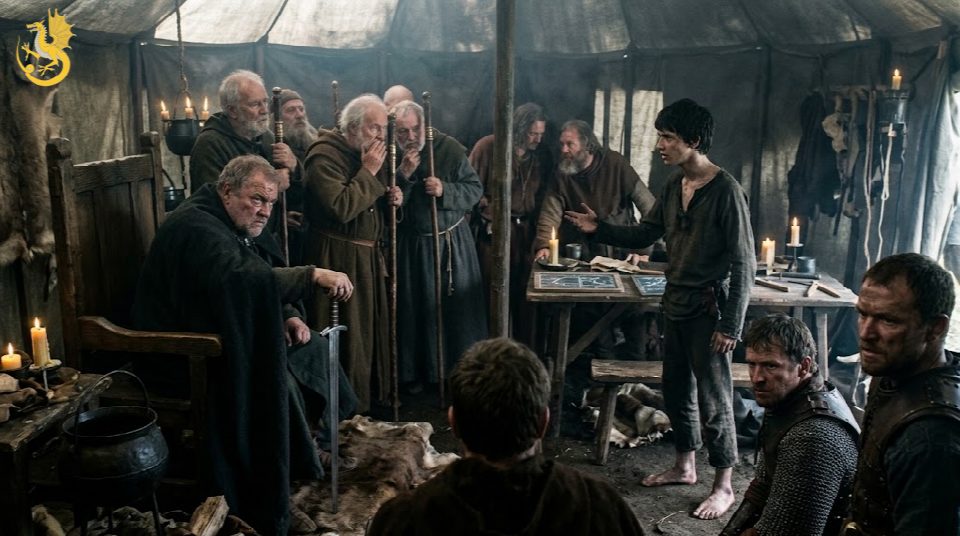
The war-tent at Dinas Emrys was thick with the odours of tallow, wet wool, and stale mead. Documented
Rhodri Mawr occupied an oaken chair, his cloak drawn tightly against the mountain breezes. The court seers formed a semi-circle behind him, their rowan staffs firmly planted in the earthen floor.
When the guards pushed the boy through the leather hangings, the elders recoiled. He was spattered with dry peat, barefoot, and reeking of river silt and wood smoke.
“Is this the unparented blood?” Rhodri asked, his voice low.
“He was found in the ditch at Caerfyrddin,” the captain reported. Documented “A magistrate’s son struck him and branded him fatherless before the entire town. The midwife who delivered him from his dying mother swore on God that no mortal father ever claimed him. He has no clan. His life belongs to the King.” Documented
Cynfarch, the chief seer, stepped forward, raising a bronze bowl.
“The sun touches the ridge, King. Let the earth drink. Let us pour the unowned blood upon the collapsed footings, and the spirits of the mountain will permit the curtain wall to rise.” Tradition
Rhodri scrutinised the boy. “Do you understand why you are here, lad?”
The boy did not look at the King. Instead, he fixed his gaze on Cynfarch.
“He wants to slit my windpipe because he cannot construct a ditch.”
The bards gasped. One of the younger priests reached for the boy’s hair to drag him down, but Rhodri raised a heavy, scarred hand.
“Hold.” The King leaned forward, his grey eyes locked onto the youth. “You possess a sharp tongue for an orphan with a bronze bowl awaiting your chin.”
“I am an orphan, yet I am not blind,” the boy replied. He stepped directly towards the table where the King’s builders had laid out their chalk-marked slate boards. “Your seers tell you the mountain is angry. They claim it demands blood. They assert that because if they admit they cannot read the bedrock, you will strip them of their silver torcs and send them to tend swine in Anglesey.” Documented
Cynfarch’s face darkened with rage. “Insolent whelp! The spirits of Dinas Emrys…”
“The spirits of Dinas Emrys are water and iron!” the boy shouted, his voice cracking like a whip across the hushed tent.
He spun to face the seated King, his finger pointing like a spearhead.
“And you sit there listening to them like another Gwrtheyrn!”
A collective gasp sucked the air from the pavilion. Two captains instantly drew their swords, the bards crossed themselves in horror at the name.
To invoke Vortigern, the despised king who had surrendered Britain to the Saxon hordes and sought the slaughter of an innocent child on this very hill, was an act of treason punishable by immediate death.
Rhodri’s knuckles turned white against the carved armrests. His jaw clenched, but his hand remained raised, freezing his captains in place.
“You call me Gwrtheyrn?” the King whispered, his quiet voice far deadlier than a shout.
“I call you a king who allows blind priests to bury his dynasty in mud,” the boy replied without flinching. “Gwrtheyrn tore this mountain apart searching for demons when he should have examined the drainage.
Now tell me, King, you who battles with Mercian iron: what lies beneath the floor of this tent? What lies three spans beneath the rock where your masons laid their stone?”
Silence enveloped the assembly.
“Bedrock,” Rhodri spoke slowly.
“Rotted shale!” the boy retorted. He pulled the dark pebble and the river stone from his tunic. “Bring your masons. Bring your picks. Let these grey-haired singers take a shovel into their soft hands. If I do not reveal to you why your wall collapsed, cut my throat and smear me across the rocks. But if I show you the true veins of this hill, you will break their staffs and heed the stone.”
Rhodri surged to his feet, kicking the oaken chair back into the dirt. He loomed over the boy, a broad-shouldered titan seasoned by a decade of border conflict.
“To the summit,” the King commanded.
Revealing the Subterranean Reservoir
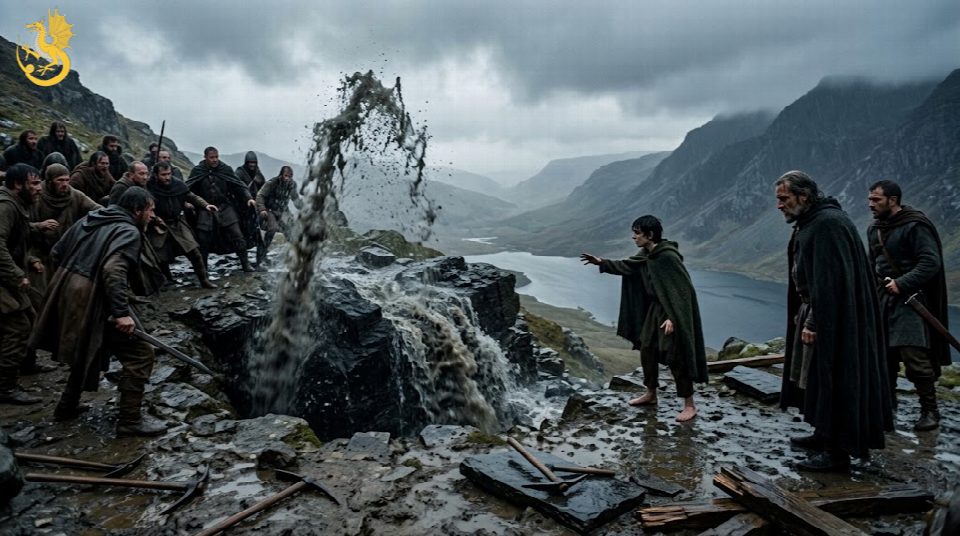
The wind howled on the scarp, whipping mist out of the cwms.
The labourers, masons, and household guard gathered around the collapsed trench where the red mud continued to ooze. The boy walked across the debris, ignoring the cold that would have numbed ordinary feet. He halted ten paces back from the edge of the scarp, knelt, and pressed his ear flat against the exposed rhyolite bedrock.
He tapped the stone with his handheld river cobble.
A rhythmic strike followed, stone on stone.
He shifted two paces west, tapping again.
The note altered. It transformed from a dull, flat sound to a deep, hollow, resonating hum, the echo of an empty cistern beneath a floor.
“Here,” the boy proclaimed, standing up. “Break this cap.”
The masons glanced at Rhodri. The King nodded.
Iron-tipped picks struck the stone. The surface crust was tough volcanic rhyolite, but beneath it lay fractured, water-softened slate. Within twenty minutes of urgent digging, a pick broke through.
A hollow, sucking gasp echoed from the earth.
The labourers recoiled as a violent torrent of black, subterranean water erupted from the breached fissure, spraying an icy sludge across the rock that reeked of bog-iron sulphur, decay, and ancient, stagnant cold.
Cynfarch staggered back, gripping his rowan staff with white knuckles, gagging as the belly of the crag vented its foul stench over the penteulu.
Myrddin did not flinch; he stepped straight into the spray, wiping the muddy slurry from his cheek with the back of his hand, watching the dark tide carve its new channel toward the valley below.
“Widen it!” the boy commanded.
The men levered the fractured slabs aside. Below them lay an enclosed subterranean pool, a natural reservoir trapped in a fault line between the volcanic neck of the hill and the impermeable slate strata beneath. Documented
The heavy autumn rains had filled the cavern to capacity; the hydrostatic pressure had saturated the clay sub-layer, transforming the entire foundation of Rhodri’s curtain wall into a liquid slip-plane.
The court bards stood silent, their staffs trembling in their hands.
“A pool,” Rhodri breathed, peering down into the black water. “The hill is hollow.” Tradition
“It is not merely a pool,” the boy replied. He pointed into the depths where the cold water began to swirl toward the newly opened breach. “Observe the currents.”
Beneath the surface, two distinct subterranean springs fed the chamber from opposite sides of the mountain fault.
From the western cleft, slicing through an iron-ore vein in the mountain’s roots, surged a violent, heavy current infused with red, oxidised clay. It roiled like boiling blood, thick and heavy, tearing at the gravel bank.
From the eastern fissure, cutting through a seam of pure kaolin and quartz silt, rushed a cold, pale, milky-white torrent, swift and freezing, carving clean lines through the murk.
The two currents converged in the centre of the subterranean cistern, clashing like two living beasts locked in perpetual combat, the red silt swirling against the white foam, ripping the gravel bed apart.
The soldiers peered into the abyss, crossing themselves or clutching ancestral amulets.
“The Red and the White,” Rhodri murmured, his voice trembling. Tradition
The boy stepped to the very edge of the hole, gazing down into the swirling silt.
“There are your dragons, King,” the youth whispered, his eyes alight in the grey mountain light. “The White represents the foreign serpent, the Saxon, the Angle, the Mercian spearmen advancing through the eastern passes with their iron and their cold hunger. The Red embodies the dragon of our people, the blood of the ancient bedrock, broken, driven down into the dark, yet refusing to yield its channel.” Tradition
He turned back to face the King and his alarmed bards.
“You can pour the blood of ten thousand boys over this hill, Rhodri ap Merfyn, and the waters will still mock you. The mountain demands no blood; it requires an engineer. Construct a drain through the southern scarp. Channel the white stream out towards the Glaslyn. Documented Lower the water level beneath the stone shelf, set your oak beams on the dry granite ridge thirty paces north, and your walls will endure until the day of judgement.”
Rhodri shifted his gaze from the swirling subterranean currents to the wild, ragged youth standing on the brink of the pit.
The King turned slowly towards Cynfarch and the court bards.
“You requested the blood of a child,” Rhodri said, his voice chillingly quiet. “Because you could not hear the water flowing beneath your own sandals.”
Cynfarch fell to his knees. “My King… the signs…”
“Seize their torcs,” Rhodri ordered the captain of his guard. “Shatter their staffs. If I see their faces in Gwynedd before the spring thaw, hang them from the oaks in Nant Gwynant.” Documented
The guards moved in. There were no protests; the bards were stripped of their bronze and driven down the sheep path into the valley mist.
Forging the Dragon Torc and the Bedrock Pact
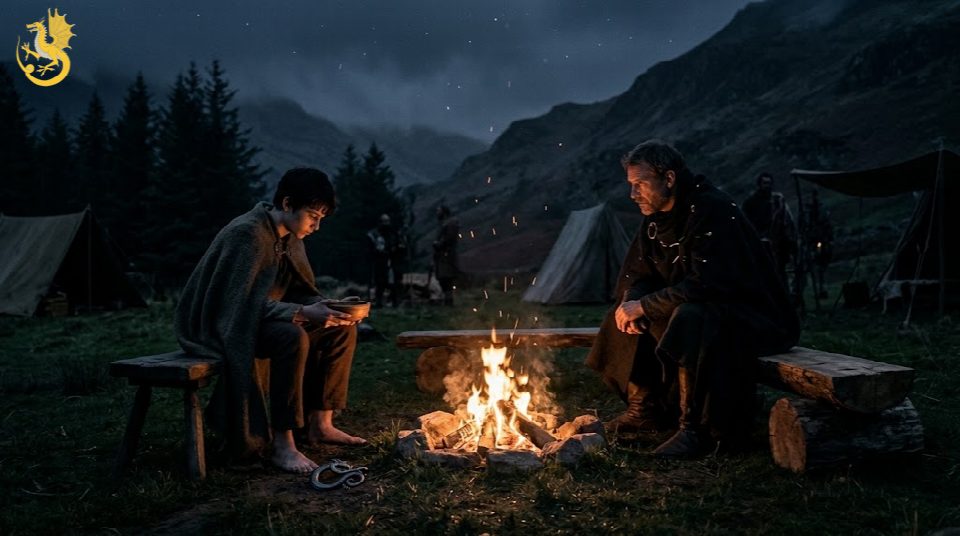
That evening, the fires in the lower valley blazed brightly.
The digging crews were already carving the drainage ditch through the lower terrace; the sound of rushing water echoed through the pines as the hidden pool began to release its fury into the river below.
Beside the central fire sat the youth.
He had cleansed the mud from his limbs in the stream, but he still donned the ragged wool cloak pinned with the boar’s tusk. In his lap rested a wooden bowl of stewed mutton and barley that the King’s own steward had provided for him.
Rhodri approached the fire alone, leaving his captains at the perimeter. The King tossed a dry log onto the embers, sending a flurry of sparks towards the mountain stars.
He settled onto a split-log bench opposite the youth.
“The builders inform me that the water is receding,” Rhodri remarked. “The rock is solidifying beneath the pick.”
The boy chewed his mutton slowly. “I told you it would.”
“Where did you acquire your knowledge of stone?”
The youth gazed into the heart of the coals. “The old woman in the marsh taught me which plants draw water from deep fissures. The rest is simply listening. When you strike a stone, it reveals what it holds. Men speak too much to hear it.”
Rhodri observed him across the flames. He detected no fear in the youth, but rather the cold, untainted clarity of a mind untouched by courtly flattery or ecclesiastical Latin.
“Your mother is dead,” Rhodri stated. “The midwife claims no rights over you. The law decrees you have no cenedl, no clan to pay your debts, no hearth to shelter you.” Documented
The youth looked up from his bowl. “Then I shall sleep beneath the crags, as I did before.”
“No,” the King replied, his voice lowering, stripped of royal distance.
He reached into his belt and produced a heavy, coiled band of iron and beaten silver, forged in the likeness of a double-headed dragon; an arm-torc thick enough to withstand a sword-blow.
He threw it across the fire. It landed on the turf with a heavy thud, resting next to the boy’s bare feet. Documented
“You will sleep under my shield,” Rhodri declared, his voice flat with royal authority.
“I have sons who know how to plant an ash spear and break a shield-wall, but I have no man who understands the earth’s structure. You will stay at my side. When I march, you march. When I build, you will survey the rock.”
The youth gazed down at the coiled dragon glimmering against the dark grass. He hesitated to touch it.
“And what will your captains call the ditch-boy from the south?”
“Whatever name you answer to in the mud of Caerfyrddin,” Rhodri replied. “What did they name you?”
The youth’s jaw tightened. “The town boys called me Myrddin. A gutter-name for a dog without a clan, marked by the fort I slept under.” Tradition
Rhodri leaned forward, his scarred face illuminated by the embers of the hearth.
“The bards named this hill Dinas Emrys because they believed the spirit of Ambrosius held the stone. Tradition But the ghost did not safeguard my walls. You did. If the ditch-dwellers spat the name Myrddin at you in the mud of Caerfyrddin, in Gwynedd you will bear the weight of this rock. From this night forth, by my word and by the bedrock beneath us, you are Myrddin Emrys.”
The boy sustained the King’s gaze through the smoke. Slowly, he reached down into the dirt, his fingers closing tightly around the heavy iron dragon.
“And if the mountain speaks against your plans, King?”
Rhodri rose, casting a long shadow across the valley grass.
“Then you will tell me what the mountain said, and I shall adjust the plans. Take up the oath-ring, Myrddin Emrys. Tomorrow, we lay the first true stones.”
Further Reading for Enthusiasts
The following sources offer historical accounts, native Welsh manuscripts, archaeological insights, and textual traditions pertinent to this chapter:
-
Annales Cambriae (Annals of Wales), Fordham University Internet Medieval Sourcebook. Documents the historical 853 Mercian invasion of North Wales led by King Burgred, supported by King Æthelwulf of Wessex. Documented
-
The Anglo-Saxon Chronicle, Yale Law School Avalon Project. Records the joint West Saxon and Mercian military expedition into Wales against King Burgred’s opponents in 853. Documented
-
Llyfr Du Caerfyrddin (The Black Book of Carmarthen), National Library of Wales, Peniarth MS 1. The earliest surviving Welsh-language manuscript (c. 1250), preserving the native verse traditions of Myrddin, his connection to Caerfyrddin, and early topological stanzas. Tradition
-
Brut y Brenhinedd (The Chronicle of the Kings), National Library of Wales. The medieval Welsh translations of insular history, preserving the vernacular names of Myrddin Emrys, Dinas Emrys, and the native dialogue of the Red and White dragons (Y Ddraig Goch and Y Ddraig Wen). Tradition
-
Trioedd Ynys Prydein (The Welsh Triads), ed. Rachel Bromwich. Preserves native mnemonic traditions regarding the three concealed dragons of Dinas Emrys and early Brythonic war-leaders. Tradition
-
Historia Brittonum (History of the Britons), attributed to Nennius, Chapters 40–42. The 9th-century Latin witness preserving the tradition of the failing mountain fortress, the demand for a fatherless child (puer sine patre), the subterranean pool, and the two fighting serpents. Tradition
-
Historia Regum Britanniae (The History of the Kings of Britain), Geoffrey of Monmouth, Book VI, Chapters 17–19. The 12th-century Latin adaptation that situates the brawling boys at the town of Caerfyrddin (Carmarthen) and introduces the name Merlin to the earlier Ambrosian foundation narrative. Tradition
-
Dinas Emrys: Iron Age Hillfort and Archaeology, The National Trust. Archaeological overview of the rocky hillfort near Beddgelert, confirming extensive Iron Age and early medieval fortifications, bedrock hydrological channels, and an engineered cistern dating to the sub-Roman and early medieval periods. Documented
-
Roman Carmarthen (Moridunum), People’s Collection Wales. Documentation of the Roman civitas, road networks, and surviving earthworks of the Roman amphitheatre at Carmarthen (Caerfyrddin). Documented
-
Cyfraith Hywel: The Law of Hywel Dda, National Library of Wales. Native Welsh legal codes (including the Book of Iorwerth and Book of Blegywryd) governing blood-liability (galanas), kin-group protection (cenedl), and the vulnerable legal status of unacknowledged children. Documented